

[Note from the Architect: 01st June 2026]
Dale Carnegie wrote How to Win Friends & Influence People in 1936.
The world he described ran on handshakes, hierarchies, and face-to-face rooms.
Gen Z inherited a different operating environment: distributed networks, ambient noise, parasocial trust, and a feed algorithm that decides whether you exist.
The rules of human connection did not change. The interface did.
This is a systems-level re-read of Carnegie for the generation that grew up online and now has to figure out how to matter in the real world, too.
~~~
Carnegie was not writing a charm manual.
He was mapping a protocol stack for human operating systems.
Every principle he laid down describes an input that produces a predictable output in the other person’s internal state.
That is systems thinking.
You are not manipulating anyone. You are designing interactions with known cause-and-effect dynamics. Gen Z, trained on UX logic and algorithmic feedback loops, should find this native.
The problem is that most Gen Z readers see the list and think it is about being likable.
It is not. It is about being effective.
There is a difference. Likability is a feeling someone has about you. Effective means you produce intended outcomes in real-world contexts: jobs secured, collaborations launched, trust built, doors opened. Carnegie was teaching effectiveness. I am passing that forward.
The Input-Output Model of Human Connection
Carnegie principles covered: Smile. / Always begin in a friendly way. / Remember and use the other person’s name.
These three are interface design.
Every app you use opens with a load state that either earns your attention or loses it. You are the app. Your first signal to another person sets their cognitive frame for everything that follows.
A genuine smile is the highest-bandwidth positive signal a human face can send. It costs zero. It has no downside. Using someone’s name activates a dopamine pathway in their brain. This is documented neuroscience, not soft wisdom.
In a world where most people feel like NPCs in someone else’s game, hearing your own name from another person signals: you are real to me.
That signal is rare. Deploy it deliberately.
Gen Z Application IRL application: You are networking at an industry event. You are nervous. You open with warmth instead of wit. You use the person’s name once in the first exchange and again when you close the conversation. You are now more memorable than 90 percent of the people they spoke to that day. Systems win over vibes.
The Feedback Architecture
Carnegie principles covered: Give honest and sincere appreciation. / Publicly praise the other person’s accomplishments. / Show respect for other people’s opinions.
Carnegie’s most misread cluster. Gen Z often processes appreciation as cringe because the internet trained everyone to be ironic.
Sincere is suspicious. But here is the system’s insight: appreciation is a signal that tells someone their output registered.
Most humans walk through the world uncertain whether their work lands.
Genuine, specific appreciation closes that loop. It is not flattery. Flattery is generic. Appreciation is precise. “That slide deck you built changed how our team thinks about the problem” is appreciation. “You’re so talented” is noise.
Public praise compounds the effect by expanding the audience for the signal. In feed terms, you are quote-posting someone’s contribution where it will be seen. That is social capital transferred to them at no cost to you.
Respect for opinions is not agreement. It is an acknowledgment that their reasoning process has value.
You can disagree with the conclusion and still respect the thought’s architecture.
Gen Z Application Creator economy application: You build in public. You see a smaller creator doing something sharp. You call it out specifically and publicly. You just gave them a signal boost and built a genuine connection. That person remembers. Ecosystems are built this way, not by hoarding recognition.
The Listening Protocol
Carnegie principles covered: Let the other people do all the talking. / Be a good listener. Let the others do more talking. / Talk in terms of the other person’s interests.
These are three variations of the same system principle: reduce your own output to increase the other person’s signal.
Most people listen to respond. Carnegie is asking you to listen to understand. The distinction is architectural.
When you listen to respond, your working memory is occupied with your own next move. You miss data. When you listen to understand, you are running a real-time model of the other person’s mental state, motivations, and priorities.
That model makes you more useful to them and more effective in the interaction. Talking in terms of their interests is the model’s output. You are not performing interest. You are translating your ask or your value proposition into their frame.
This is not manipulation. Every well-designed product does exactly this. You meet the user where they are.
Gen Z Application Job interview application: You research the company’s actual pain points before walking in. You frame every answer in terms of their problem, not your resume. You ask one sharp question that proves you listened. You are now operating at a different level than candidates who pitch themselves. You are offering a solution.
The Conflict Diffusion Stack
Carnegie principles covered: To get the best of an argument, avoid it. / Ask questions rather than giving orders. / When wrong, admit it quickly and definitively. / Let the other person save face.
This is Carnegie’s most counterintuitive cluster and the one Gen Z most needs right now.
Discourse culture rewards the opposite: defend your position loudly, never concede, make the other person look wrong in public.
Carnegie identified this as a losing strategy, even when you win the argument.
You can win the argument and lose the relationship, the collaboration, the deal, or the hire. Winning an argument changes no one’s mind. It just produces a person who was defeated and is now looking for a way back.
Asking questions instead of giving orders is a power move that appears to be deference. You are not surrendering authority. You are inviting the other person into the reasoning process so they own the conclusion.
When you are wrong, admit it fast and fully. This is a system reset. A quick, clean admission drains the conflict of its energy. It is the fastest path through.
Letting someone save face is not a weakness. It is the difference between a resolved conflict and a festering one.
Gen Z Application Online discourse application: You are in a comment thread. Someone is wrong about something you care about. You have two options. Option A: Correct them publicly, win the argument, lose the person. Option B: DM them, ask a question, find the part of their argument that has merit, and build from there. Option B produces a changed mind. Option A produces a screenshot war.
The Motivation Architecture
Carnegie principles covered: Arouse an eager want within the other person. / Become genuinely interested in other people. / Go out of your way to make people feel important.
Carnegie’s core insight here is that motivation is not pushed; it is pulled.
You cannot make someone want something. You can design conditions where their existing wants align with the action you need.
Becoming genuinely interested in other people is the prerequisite. Genuine means not performed. Gen Z has finely calibrated detectors for performed interest. They grew up watching influencers fake engagement.
The real thing reads differently. When you are actually curious about someone, they feel it. That curiosity creates psychological safety, which creates openness, which creates collaboration.
Making people feel important is not about ego management. Most people spend their days feeling unseen. They are a headcount in a meeting, a user in a funnel, a follower in a feed. The person who sees them specifically, who treats their contribution as irreplaceable, creates loyalty that no incentive structure can buy.
Gen Z Application Team and community application: You are building something with people. You are not the loudest voice. You are the one who knows what each person cares about and makes sure that thing is present in the work. People do not burn out from hard work. They burn out from feeling invisible. Design against that.
The Praise Architecture
Carnegie principles covered: Always begin with praise and appreciation. / Let the other person save face (feedback context).
Separate from the conflict stack, Carnegie describes a specific sequence for delivering feedback or correction: open with genuine appreciation, then deliver the correction, then close with acknowledgment of the person’s capacity to act on it.
This is not the classic sandwich. The classic sandwich is cynical, and everyone knows it.
Carnegie’s version works because the opening praise is earned and specific. It establishes that you have actually been paying attention. When the correction lands inside that frame, it is received as coming from someone who sees the whole picture. In contexts where Gen Z leads teams, manages peers, or gives creative feedback, this architecture produces outcomes.
Feedback delivered without this frame produces defensiveness. That defensiveness costs you iteration cycles.
Gen Z Application Creative collaboration application: You are reviewing a teammate’s draft. It is not working. You open with the specific thing that is strong. You describe the gap as a design problem, not a talent problem. You close with your confidence in their ability to close it. You get a better next draft. More importantly, you preserve the trust.
The Perspective Protocol
Carnegie principles covered: Try to see things from the other person’s point of view. / Don’t criticize, condemn, or complain.
Carnegie closes with what is, in systems terms, a model update.
You are not just managing your behavior. You are actively running a simulation of the other person’s position, constraints, history, and fears.
When you operate from inside that simulation, criticism, condemnation, and complaint become structurally unavailable. Not because you are suppressing them. Because from inside their frame, the behavior that triggered you makes sense.
Not the right sense. But logical sense given their operating conditions. This reframe does not mean you have no standards. It means you respond to failure modes with curiosity instead of judgment.
In a distributed, multi-stakeholder world where you will work with people across massive context gaps, this is not a soft skill. It is the core competency.
Gen Z Application Cross-cultural work application: You are collaborating with someone operating in a completely different context, maybe a different country, generation, or industry. Something they do frustrates you. Before you react, you run the simulation. What would their behavior make sense in light of what they know and where they came from? That question changes your response. And your response changes the outcome.
The Four-Principle Collapse: What Carnegie Was Actually Teaching
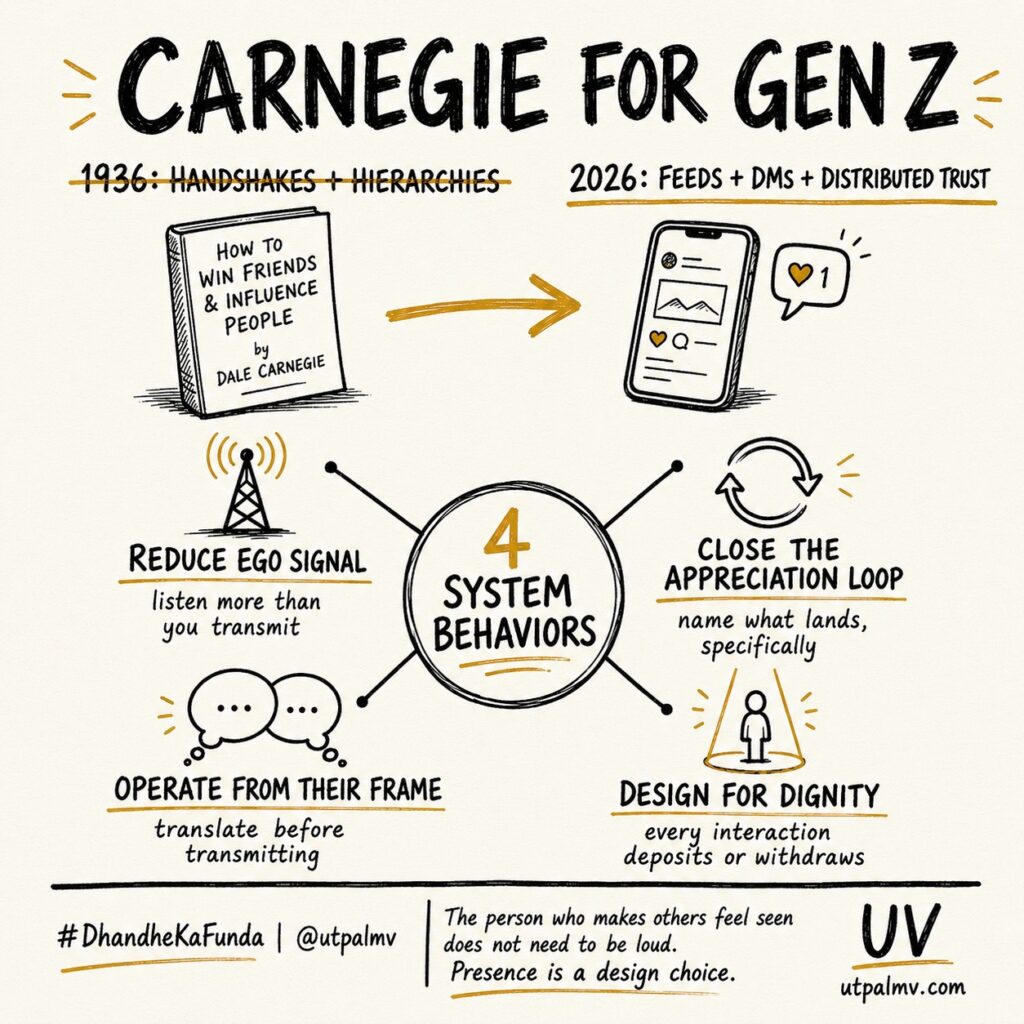
Carnegie’s 19 principles are not 19 separate things to remember. They collapse into four system-level behaviors:
- One. Reduce the ego signal. Your visibility in the interaction should be calibrated to what the outcome requires, not what your insecurity demands. Most people signal too much. Transmit less. Listen more. Let the other person exist fully in the space.
- Two. Close the appreciation loop. Most people walk through the world with open feedback loops. Their contribution went out, and nothing came back. Close those loops specifically and sincerely. You become a reliable signal in a noisy environment.
- Three. Operate from their frame. Before you speak, before you send, before you act, run the other person’s model. What do they need from this interaction? What are their constraints? What would make this land for them? Translate into their frame before transmitting.
- Four. Design for dignity. Every interaction you have with another person either deposits or withdraws from their sense that they matter. Carnegie built a whole system on the insight that making people feel valued is not just kind, it is strategically superior. Sovereign operators understand this. They design every interaction to leave the other person more functional, not less.
#DhandheKaFunda: The person who makes others feel seen does not need to be loud. Presence is a design choice.