

From the Architect — July 12, 2026
Every year, I run the same diagnostic on my own life. This is what it looks like from the inside.
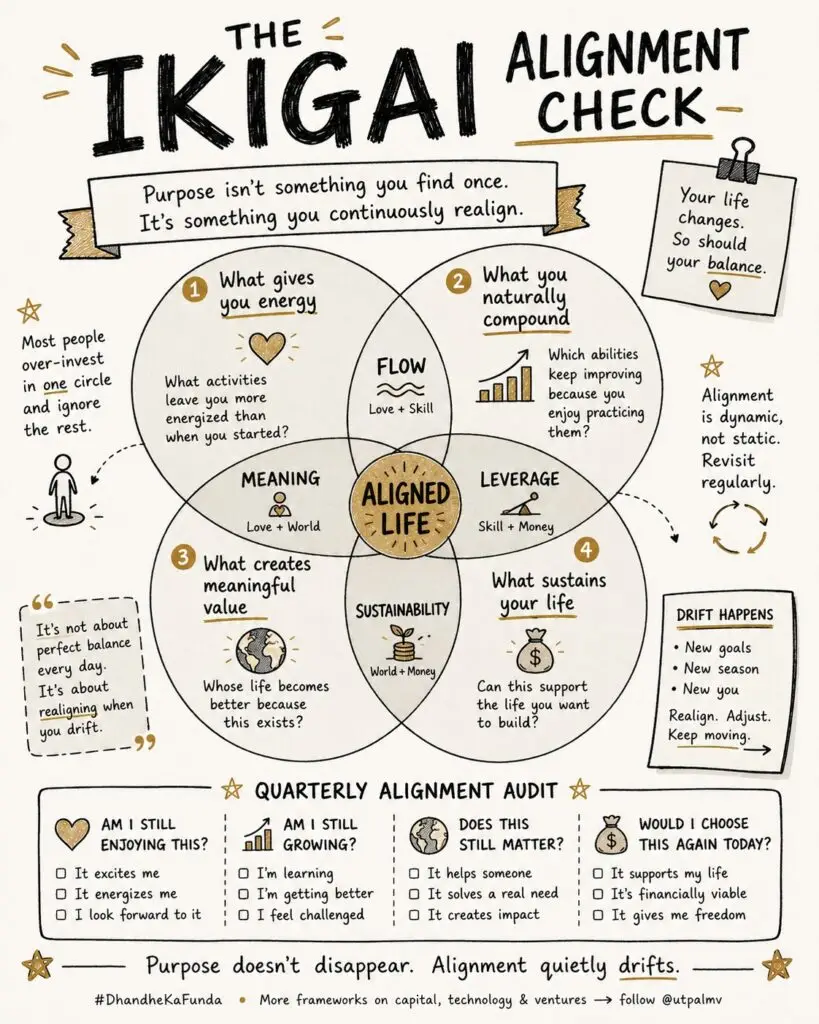
Ikigai is one of the most misunderstood frameworks I know.
Most people use it to find purpose. A treasure hunt with four circles. Find the intersection, frame it, done.
I stopped using it that way years ago. I use it for something else now.
Alignment.
The Drift Nobody Announces
Every time I revisit the framework, I notice the same pattern. Life has quietly drifted.
Maybe the work is financially rewarding but no longer energizing. Maybe I am learning, but no longer contributing to something that feels meaningful. Maybe I am solving important problems while neglecting the life that makes those problems worth solving.
Nothing dramatic happened. No crisis. No breakdown. Just a few degrees of drift.
That is the danger. A system rarely fails due to a single catastrophic event. It fails through small, uncorrected deviations that compound in silence. A ship that is one degree off course does not feel lost. It arrives at the wrong continent.
[Architect’s Note] The most expensive drift is the one that pays well. When a misaligned position is financially rewarding, the incentive to audit it disappears. The money becomes anesthesia.
Four Circles, Four Questions
The classic Ikigai diagram maps four territories: what you love, what you are good at, what the world needs, what you can be paid for. Useful, but static. I run it as a live diagnostic instead. Four questions, asked in the present tense:
- What gives you energy. Not what you liked five years ago. What activities leave you more energized than when you started? Energy is the rawest signal in the system. It does not lie, and it does not care about your narrative.
- What you naturally compound. Which abilities keep improving because you enjoy practicing them? Skill without enjoyment plateaus. Skill with enjoyment compounds. This is where leverage lives.
- What creates meaningful value. Whose life becomes better because this exists? Not in the abstract. Name the person, the founder, the team, the node in the system that is measurably better off.
- What sustains your life. Can this support the life you want to build? Purpose that cannot pay its own rent is a hobby wearing a costume.
The intersections matter more than the circles. Love plus skill is flow. Skill plus money is leverage. Love plus world is meaning. World plus money is sustainability. All four together is an aligned life.
Most people over-invest in one circle and ignore the rest. The specialist who compounds skill but starves meaning. The idealist who compounds meaning but starves sustainability. Both are misaligned systems. Both will eventually seize.
The Recalibration Protocol
Here is the core shift: I no longer think Ikigai is something you find. It is something you continuously recalibrate.
Because the four circles move.
You change. Your skills change. The world changes. The work that once sustained you may no longer challenge you. The work that once inspired you may no longer fit your life.
Purpose is not a destination. It is an ongoing alignment between who you are becoming and what you choose to build next.
So I run a quarterly audit. Four checks, one per circle:
- Am I still enjoying this? It excites me. It energizes me. I look forward to it.
- Am I still growing? I am learning. I am getting better. I feel challenged.
- Does this still matter? It helps someone. It solves a real need. It creates impact.
- Would I choose this again today? It supports my life. It is financially viable. It gives me freedom.
That last question is the sharpest blade in the kit. Not “should I quit” but “would I choose this again today, knowing everything I now know.” Sunk cost dissolves under that question. Only present-tense alignment survives it.
[Architect’s Note] It is not about perfect balance every day. It is about realigning when you drift. Drift happens: new goals, new season, new you. Realign. Adjust. Keep moving.
I revisit this framework every year. Not to discover a new purpose. To notice where I have quietly drifted.
Look at the visual. Which of the four circles have you been neglecting lately?
#DhandheKaFunda: Purpose rarely disappears. Alignment quietly drifts.