

[A Note from the Architect]
On April 23, 2026, I am auditing a specific failure of leadership presence.
The failure is quiet, structural, and expensive.
It shows up in the meeting that had my calendar invite, but not my attention.
In the meeting you attended last week, you were physically present but mentally absent.
In the meeting that was conducted but not held.
I have been calling this pattern BUSYness, in the project I am co-creating with Manoj Onkar, Kill BUSYness: Get High Performance.
The conventional framing treats BUSYness as a time management fault. That framing is wrong.
BUSYness is an architectural fault in the leader. Time management is only its most visible symptom.
The structural claim
BUSYness is not the state of having too much to do.
BUSYness is the state of being elsewhere while appearing to be here.
The busy leader’s body is in the room.
The decisions still get made.
The calendar still resolves.
Nothing visible is missing.
What is missing is the one resource the organization cannot reproduce without the leader: the quality of attention at the point of decision.
Attention, when it is absent, leaves no immediate trace.
It leaves a delayed trace. A decision made without listening.
A team member who quietly decided not to surface the hard thing.
A customer signal that arrived on time but never landed.
A culture that learns, slowly and then all at once, that showing up is ceremonial.
The teaching function of absence
This is the part I am sitting with this week.
A leader’s presence, or absence, is not a private matter. It teaches.
When the leader is absent, the organization learns a lesson. The lesson is that presence is optional. That the real work happens elsewhere. That meetings are a container to be endured, not a field where reality is made.
The lesson spreads fast, and not because people are cynical. It spreads because people are intelligent. They watch what the top of the hierarchy treats as real, and they match it. Whatever you practice at the top, the organization practices at scale.
This is why BUSYness cannot be fixed at the level of calendars, tools, or delegation. It is built at the top, normalized in the middle, and suffered at the bottom. Any fix that does not begin with the leader’s attention is a fix in the wrong layer of the stack.
Three laws
After reflecting on this, I can restate the observation as three laws. Not aphorisms. Laws, in the sense that they hold whether or not the organization notices them.
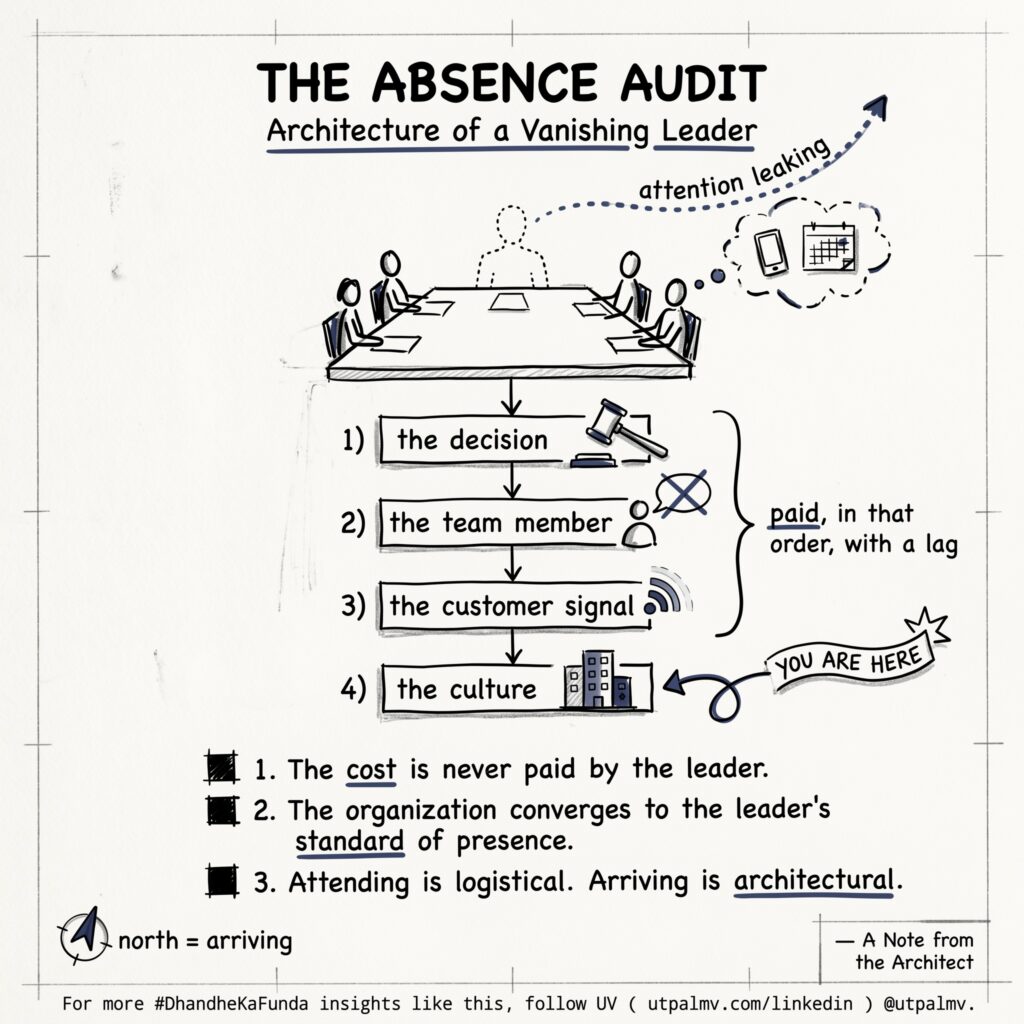
Law 1. The cost of a leader’s absence is never paid by the leader. It is paid by the meeting, the decision, the team member, and the customer, in that order, with a lag.
Law 2. An organization’s standard of presence converges, over time, to the leader’s standard of presence. The convergence is slow. It is also unconditional.
Law 3. Attending is logistical. Arriving is architectural. The two are often confused. Only one of them produces decisions worth defending.
What I am practicing this week
I am testing a single rule: for any meeting on the calendar that matters, I close every other surface. No second screen. No notifications. No drafting of the next message while in this one. If a meeting does not deserve that, I am not in it.
The first two days of this experiment have already told me something uncomfortable: a surprising number of the meetings I routinely attend do not deserve my presence, and I have been paying the cost of being partly there instead of either fully there or fully absent.
That is the next audit.
A note on register
A version of this thought is live on LinkedIn this week, under #DhandheKaFunda. It closes on a question, because inquiry is how this concern lives in a public feed.
Here in the journal, I am closing on laws, because laws are how the same concern lives in a private architecture. Different register, same concern.
The project with Manoj is, in one sense, the long form of the same question: what does it cost an organization when its leader is absent, and what would it take, structurally, to arrive at that?
I will keep auditing here.