

Structural debt begins the moment roles become ambiguous.
To maintain systemic throughput, you must decouple the Execution Engine from the Decision Engine.
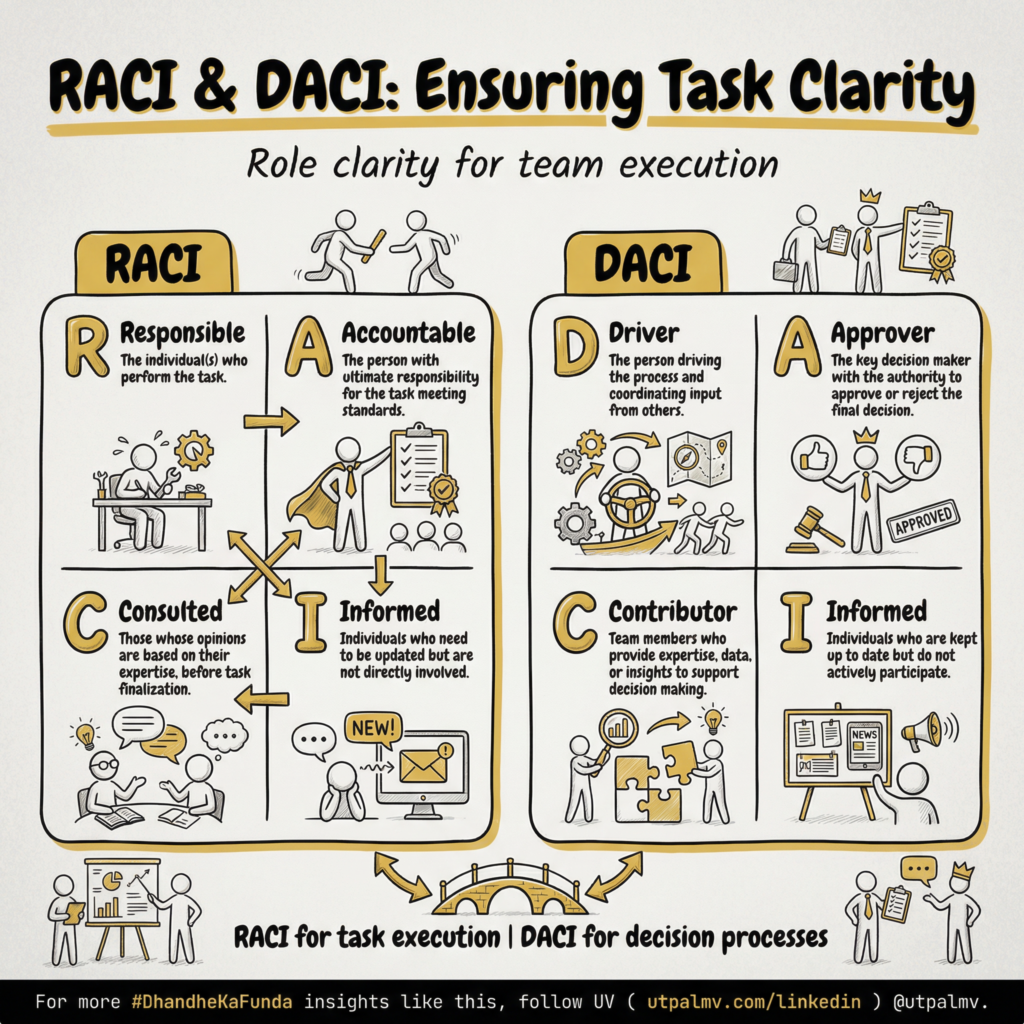
The Execution Engine (RACI)
RACI is designed for the Flow of Work. It defines how a task moves from intent to completion.
-
Responsible: The doer. The kinetic energy of the task.
-
Accountable: The owner. The single point of systemic responsibility.
-
Consulted: The experts. The data inputs are required before finalization.
-
Informed: The stakeholders. Those kept in the loop but not in the flow.
The Decision Engine (DACI)
DACI is designed for the Resolution of Choice. It defines how the system reaches a “Go/No-Go” state.
-
Driver: The facilitator. The one who drives the process toward a resolution.
-
Approver: The Sovereign. The one with the final veto and the final word.
-
Contributor: The data providers. Those who support the decision with insights.
-
Informed: The observers. Those kept up to date on the system state.
The Sovereign Law of the Approver
Execution (RACI) can have multiple workers. Decisions (DACI) can only have ONE Approver. If your system has two Approvers, you don’t have a decision-making framework; you have a negotiation. Negotiation is the death of speed.
The Directive
Identify your current bottleneck. If the work is stalling, audit your RACI. If the choice is stalling, harden your DACI.