

[A Note from the Architect]
On April 29, 2026, I am auditing how many founders I know who have “an AI strategy” but have never personally built anything with the tools.
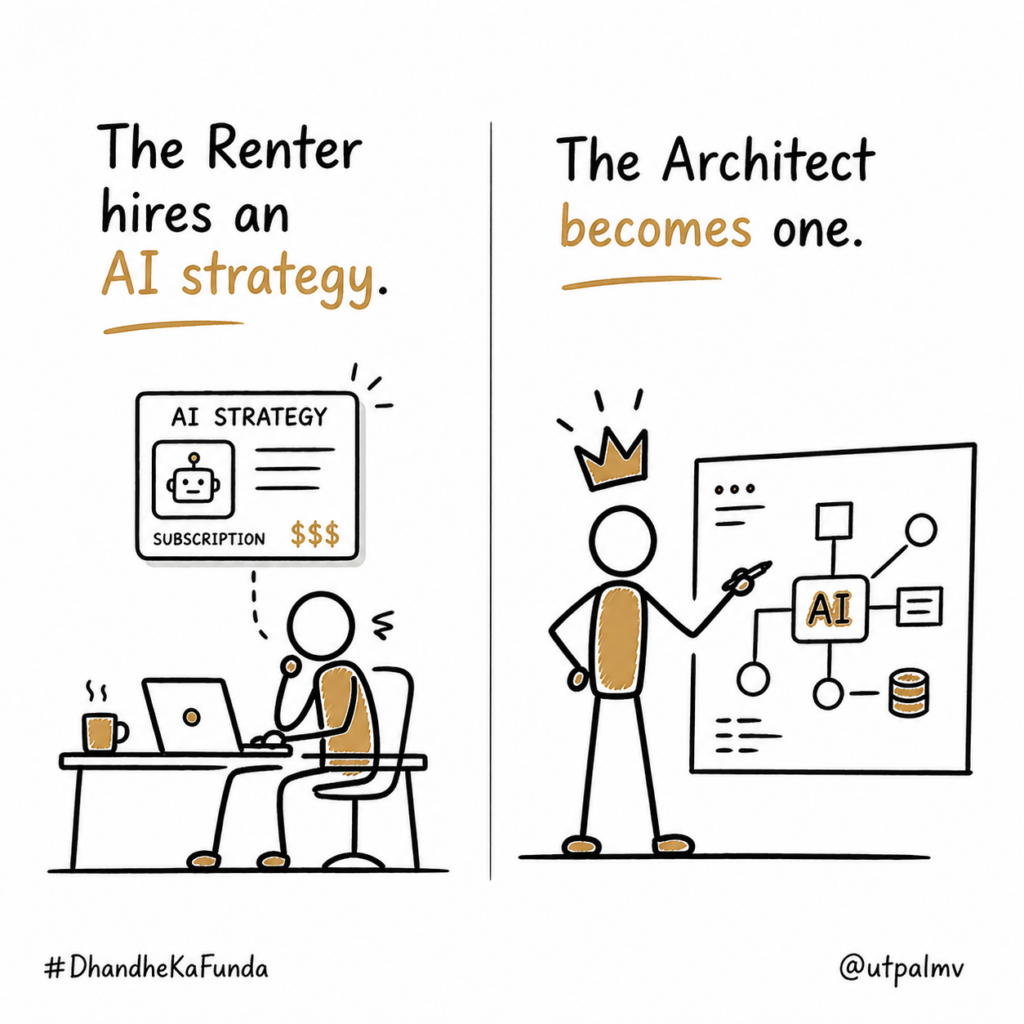
They have delegated the most important architectural decision of this decade to a VP of Innovation, a task force, or a consultant. They have treated the shift the way a Renter treats a leaking pipe: call someone else, get a report, move on.
That is not a strategy. That is abdication dressed in a roadmap.
The Founder Is the Source Code
There is a version of the AI transition that most companies are currently running.
They added Copilot to the engineering team. They approved a budget line for “AI tools.” They hired someone with “AI” in their title and handed over the brief.
And then they went back to their calendar.
This is the open-loop model. A decision gets made, work gets executed, and nothing feeds back into the system. The company does not learn. It does not compound. It just moves slightly faster in the same direction it was already going.
The Sovereign Architect runs a different protocol entirely.
The Closed-Loop Federation
Diana Hu’s framing is worth installing directly into your operating system: the difference between a legacy company and an AI-native one is not the tools they use. It is whether the company is open-loop or closed-loop.
An open-loop company executes and forgets.
A closed-loop federation executes, captures, feeds back, and improves. Every meeting generates an artifact. Every sprint produces data that an agent can inspect. Every customer signal flows into the intelligence layer and reshapes the next decision.
The company becomes queryable. Not just by humans. By the system itself.
Most founders think they are building a business. The Architect understands they are building a learning machine. The machine only learns if the loops are closed and the data flows without human middleware blocking it.
The Founder Cannot Delegate This
Here is the structural error that will separate the survivors from the casualties in this transition.
Founders who treat AI as an IT decision will be outflanked by those who treat it as a personal fluency requirement.
You cannot lead a closed-loop federation from the outside of the loop.
If you are not personally using the tools at depth, you cannot coach your team through them. You cannot recognize the real capability gain versus the marketed one. You cannot make the architectural call between what your agents should own and what still requires human judgment. You are flying the aircraft from the gate.
Diana Hu says it plainly: the founder must personally lead the shift. Not sponsor it. Not approve it. Lead it. Build with the tools. Show the team what the leverage actually looks like in practice.
This is the same logic as the Law of the Vault. If the system requires your constant metabolic intervention to survive, it is a job. But if you have never touched the system yourself, you cannot architect it. You can only hope the person you hired got it right.
Token-Maxing Is the New Capital Allocation
The sharpest reframe in this entire framework is also the most counterintuitive for founders trained in the legacy model of growth.
The best AI-native companies will not optimize for headcount. They will optimize for token usage.
One builder with the right agent infrastructure can execute what used to require a team of eight. The API bill is not overhead. It is the infrastructure cost that replaced a far more expensive coordination structure of managers, meetings, and hand-offs.
The Sovereign Architect reads this as a capital allocation decision. Every dollar spent on intelligent loops that compound is a higher-return asset than a salary that does not. The Federation stays lean. The intelligence layer does the scaling.
This is not about replacing people. It is about never building the coordination overhead in the first place.
The Directive
Audit your current position honestly.
Are you personally fluent in the tools, or do you have a summary of what your team is doing with them? Is your company capturing work as queryable artifacts, or is critical intelligence still trapped in Slack threads and someone’s memory? Are your loops closed, or are you still routing information through human middleware and calling it a process?
The AI-native company is not the one with the biggest tools budget. It is the one whose founder personally got into the system, closed the loops, and built the intelligence layer from the inside out.
You cannot architect what you have never touched.
#DhandheKaFunda: The founder who delegates the AI shift is not building a company. They are building a dependency on someone who understood the decade better than they did.