

From the Architect, July 10, 2026
Respect has a UI. Most people stop there.
The handshake. The stage time. The photograph with the right person in the frame. It is real, and it is nothing. But it is one layer of a system, and a system judged by one layer is a system waiting to fail.
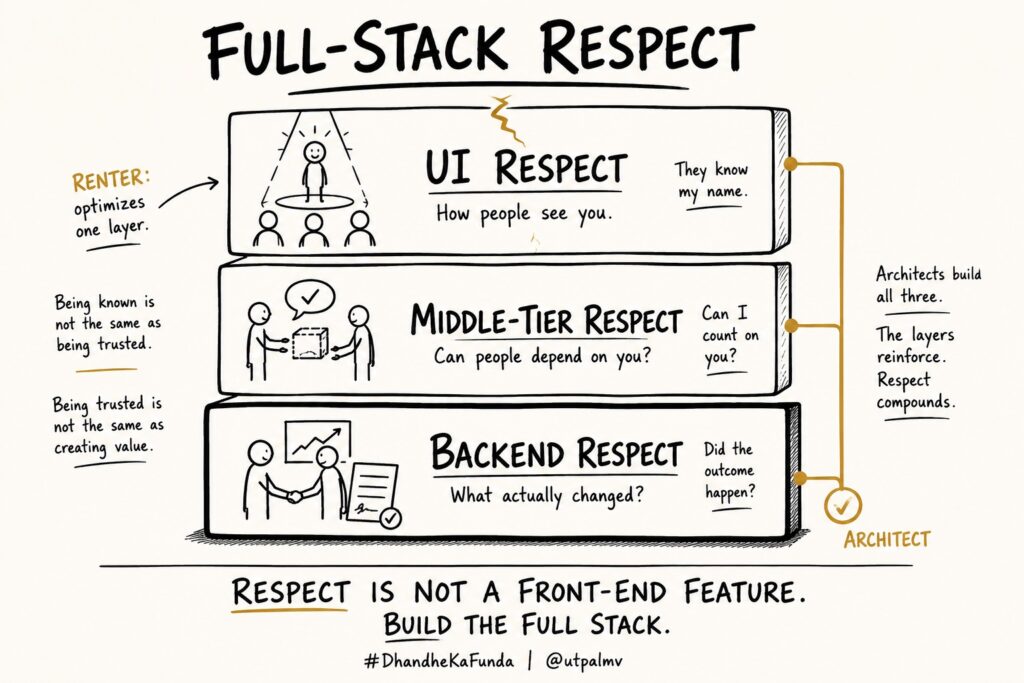
[Architect’s Note: This is a sub-framework under Renter vs. Architect. Every layer below maps back to that axis. A Renter borrows respect one layer at a time. An Architect builds all three so they compound.]
SURFACE
This is the layer everyone can see. How you are perceived in a room. Whether people know your name before you say it.
A Renter treats this as the whole job. Every event attended. Every relationship visible. The customer who is free for a meeting this week gets traded for the event that photographs well this week.
That is not networking. That is a Renter’s move, dressed as strategy.
TRANSMISSION
Beneath the surface lies the layer that determines whether intent becomes action. Can people depend on you? Do your priorities match the role you accepted, or the role you wish you had?
This layer is invisible until it breaks. A Renter’s transmission layer is thin because it was never built to carry weight. It was built to be seen carrying weight.
FOUNDATION
This is where the truth lives. Did business get created? Did customers move? Did revenue happen? Did the database change?
An Architect is judged here first and everywhere else second. A Renter avoids this layer entirely because it cannot be photographed or faked.
If the foundation is empty, the surface eventually cracks under its own weight. Every impressive layer above it becomes evidence of the gap, not proof against it.
Great network, no outcomes. Great execution, poor relationships. Great numbers, built on trust that was never actually extended. Each is a single layer wearing the costume of a whole system. Each is still renting.
An Architect audits differently. Three questions, asked in order and answered without flattery.
First: does this improve my primary outcome, or compete with it? Every yes to one thing is a no to something else, and most people never make that trade visible to themselves.
Second: when a choice appears, choose on leverage, not on excitement. The event is exciting. The customer visit is leveraged. These are not the same axis, and confusing them is where the architecture breaks.
Third: audit all three layers on their own terms. How am I perceived? How do I operate? What did I actually change? A Renter can usually answer the first question well but not the third.
[Architect’s Note: The failure mode is not a weakness in one layer. It is a mismatch between layers, the surface promising what the foundation cannot deliver. That mismatch is where credibility takes damage, slowly and then all at once.]
Build the surface. Build the transmission layer beneath it. Build the foundation beneath that. Do not stop at the layer that photographs best.
#DhandheKaFunda: Respect is not how impressive your UI looks. It is whether the whole stack works.