

From the Architect – June 27, 2026. A note on what survives when models eat everything they see.
~~~
Most firms are about to lose the most valuable thing they own without noticing. They are watching the wrong question. Which model is best? Which vendor wins? Meanwhile, the asset walks out the door, one inference at a time.
STATION ONE: The Leak
AI models eat expertise. They watch, ingest, abstract, and commoditize the accumulated knowledge of people and organizations. This is not a bug in the system. It is the system.
So here is the exposure. If your edge lives only in your people’s heads, it is already leaking. Every prompt, every workflow, every clever solve is a sample. Feed enough samples to a general model, and your hard-won advantage becomes its baseline. The renter does not see this. The renter is busy comparing subscription tiers.
[Architect’s Note: The question is never which intelligence to rent. It is which loop you own.]
STATION TWO: Two Capitals
Every firm now runs on two forms of capital, not one.
Human capital is judgment, relationships, pattern recognition, and ingenuity. The things that do not reduce to a benchmark. Token capital is the AI capability you build and own. Legacy thinking treats these as a trade. More machines, fewer humans. Spend one to buy the other.
Sovereign thinking inverts it. Human capital becomes more valuable as token capital grows, because human agency is what directs the compute. Humans set the ambitious goal. Humans connect the dots across domains. Humans recognize which patterns matter. Strip out the direction, and you have machines running in circles, burning tokens, climbing nothing.
The renter optimizes the model. The Architect builds the loop between the two.
STATION THREE: The Hill-Climbing Machine
The loop is the real asset. It is buildable and specific.
Private evals that measure a model against outcomes that matter to your business, not external leaderboards. Reinforcement environments trained on your real traces, the actual work, the actual decisions. A knowledge base that turns institutional memory into something queryable. The decisive test: swap out a generalist model, and your company veteran expertise stays. That is sovereignty. The model is a renter in your house. Learning is the house.
This loop is your new IP. And unlike most assets, it compounds. Every improved workflow generates a better signal. Better signal deepens the tacit knowledge only your firm holds. The advantage gets harder to replicate with every single use. A hill-climbing machine that you own the hill on.
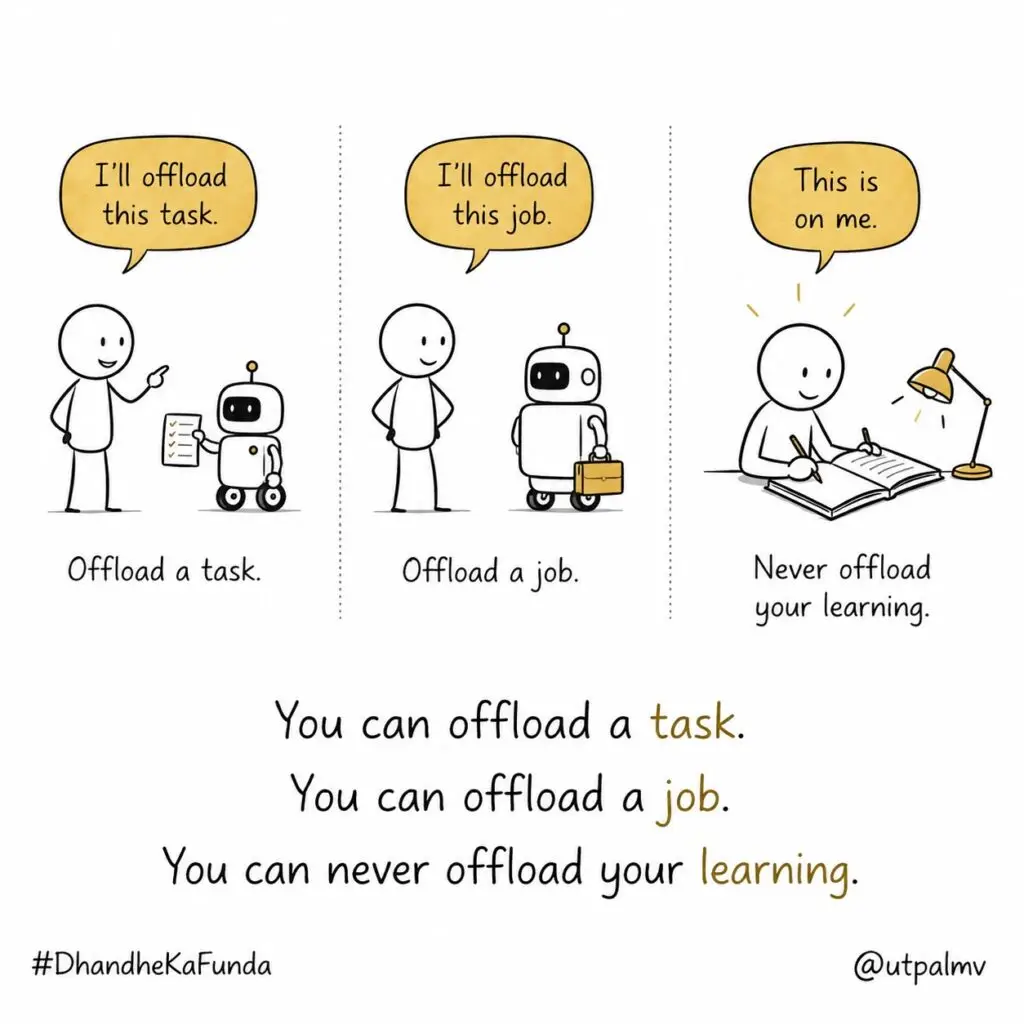
[Architect’s Note: You can offload a task. You can offload a job. You can never offload your learning.]
STATION FOUR: The Equilibrium
There is a larger reason this matters beyond any single firm.
A frontier model without an ecosystem is not a fortress. It is a bottleneck. We have watched this movie before, in the first phase of globalization, where entire industrial economies were hollowed out while the aggregate numbers looked fine on the surface. The displacement was real. The consequences are still being paid.
An AI future that captures all the returns inside a handful of systems, while every industry finds its knowledge commoditized out from underneath it, has no societal permission. The political economy will not tolerate it. The stable equilibrium is the other one. The one where every organization owns the loop that encodes its own institutional knowledge, where value flows broadly, where expertise gets amplified rather than absorbed.
That is not charity. That is the only version that holds.
Stop renting intelligence. Start compounding it.
#DhandheKaFunda: You can outsource the work. You cannot outsource the learning. Whoever owns the loop owns the future.