

Ask a person what they most want, and watch the pause.
Not evasion. Something closer to vertigo. The question lands in a place that has never been visited. Most people have spent years executing objectives handed to them and never once chosen one for themselves. So when you ask directly, the silence is not empty. It is the sound of someone meeting themselves for the first time.
The question is not diagnostic. It is the intervention.
STATION ONE: THE SILENT MAJORITY
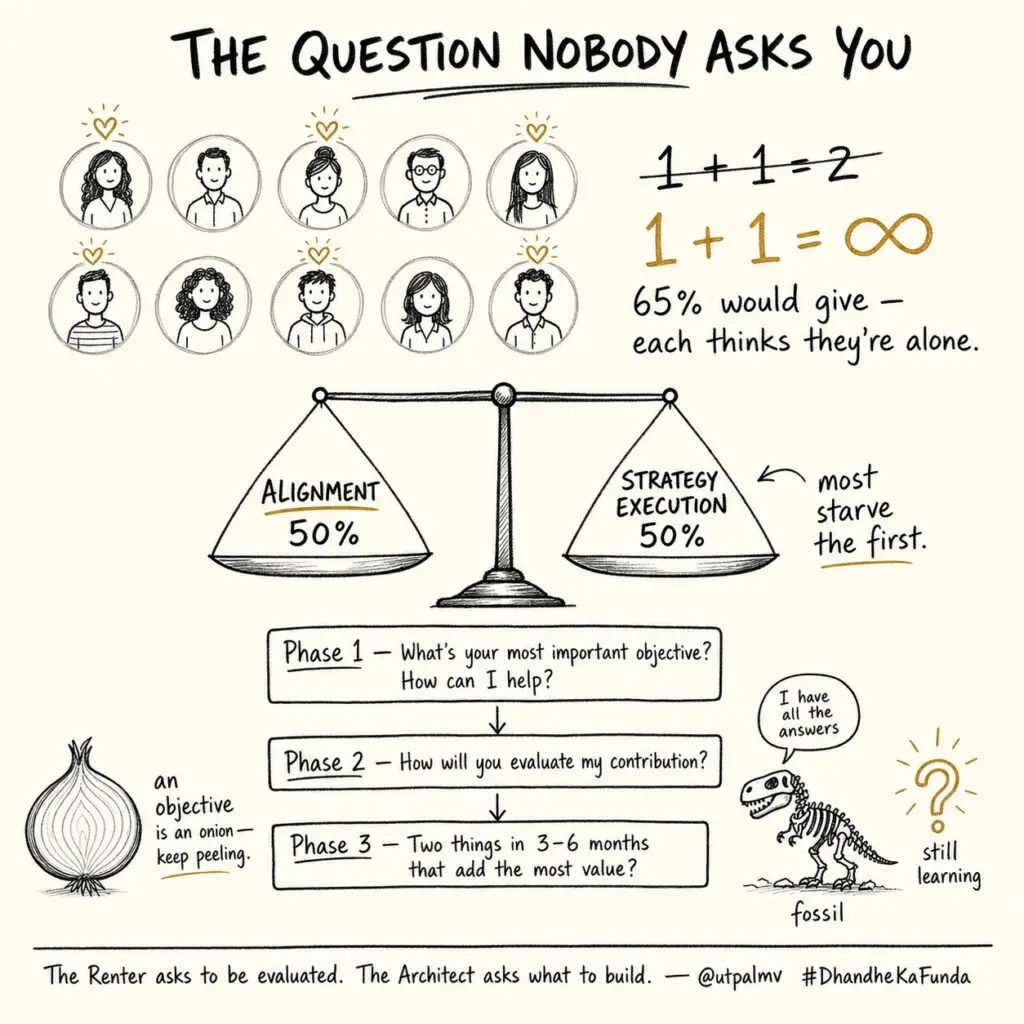
There is a number worth sitting with. Roughly 65% of people are willing to sacrifice something for a world larger than their own comfort. The majority would give.
Here is the trap. Most of them believe they are the exception. They assume everyone around them is in it for the money, the title, the exit. So they keep their willingness private. They contribute quietly and expect nothing back, because to expect would be to assume others care as much as they do.
The result is collective paralysis built entirely out of individual generosity.
[Architect’s note: This is the most expensive misalignment in any organization, and it never shows up on a balance sheet.]
Picture 200 people. 130 of them want to build something that matters. Each one is convinced they stand alone. Nothing moves. Not because the will is absent. Because the will is invisible to itself.
The moment those people discover one another, the arithmetic breaks. One plus one does not resolve to two. Aligned intent does not add. It compounds.
STATION TWO: ALIGNMENT IS NOT SOFT
We have been taught to file alignment under culture, under the soft and immeasurable. This is a category error.
Half of the outsized growth in organizations comes from people converging on a single mission. The other half is strategy and execution. Most operators pour themselves into the second half and quietly starve the first, then wonder why a brilliant strategy moves like wet cement.
You cannot execute your way out of a misaligned room. You can only out-execute the company that never aligned in the first place, and that company is rarer than you think.
STATION THREE: HOW TO SURFACE WHAT IS HIDDEN
The instrument is older than any framework. You ask. But you ask with structure and without flinching.
Phase one. What is your most important objective? And then, how can I help you accomplish it. The second question changes the relationship. The first surfaces the want. The second offers to serve it.
Phase two. What parameters will you use to evaluate my contribution? You are asking for the rubric before the exam. Most people never do, then act surprised when their effort is scored against criteria they never saw.
Phase three. If I could change two things in my area over the next three to six months, what would add the most value to you? This is the question that converts goodwill into direction.
[Architect’s note: The structure carries the weight. You are not confessing your inadequacy. You are building a map.]
STATION FOUR: THREE WAYS IT BREAKS
Do not name the process. The moment you say you want to conduct an interview, the other person performs. Ask instead if you can ask a few questions. The frame should disappear.
Do not soften the objective question. In fifteen years of teaching this, nearly everyone has tried to rephrase it in something gentler. The discomfort is not a flaw in the question. The discomfort is the question of working.
Do not accept the first answer. An objective is an onion. The first layer is the one a person has rehearsed. Keep asking what else, and the rehearsed answer gives way to the real one.
STATION FIVE: THE MOON IS GOOD NEWS
When a stakeholder places enormous expectations on you, the instinct is to feel buried. Invert it.
High expectations mean your role matters. If they ask for the moon, you are load-bearing. Low expectations are the actual threat, because they are quiet evidence that your seat could be removed and nothing would change.
Ask for the rubric. Hope it is demanding.
CLOSING
There is a final filter for whether any of this will work in you. The person with all the answers and no remaining questions has stopped learning. They have become a fossil that still attends meetings.
Reflection is the gate. A hundred books and a hundred seminars without it produce nothing but accumulated weight. The objective question, asked of others and eventually of yourself, is one of the few that reopens the gate.
So stop mining the room for what you can extract. Start asking what the room is quietly waiting to build.
#DhandheKaFunda: The Renter asks to be evaluated. The Architect asks what to build.